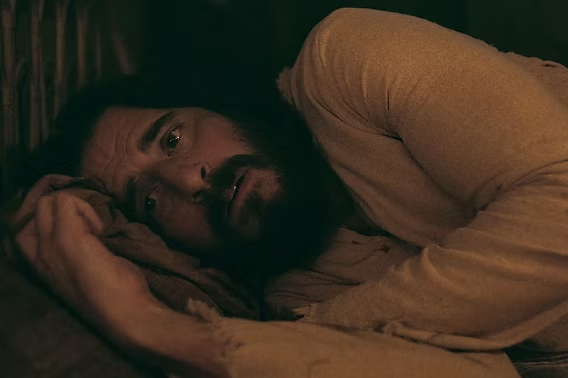
The (Grief) Journey Begins | Jesus Wept # 2

Jonathan Grubbs • Associate Pastor
August 13, 2026

2 Minute Read

John 11:35 — "Jesus wept."


The Great In-Between: Mourning and Dancing

In the middle of May, my wife, Suellen, and I walked through a Bible reading plan titled Mourning and Dancing.

Scripture deliberately pairs light and dark realities because it knows the human experience is almost never just one thing:


A Time to Mourn and a Time to Dance (Ecclesiastes 3:4)

Death and Resurrection (John 11:25)

Sin and Redemption (Romans 5:20)

Mortality vs. Eternal Life (1 Corinthians 15:53-54)


If you are grieving, you already know that life doesn't ask you to experience these in neat, isolated chapters.

More often than not, you are forced to hold a celebration in one hand and a heartbreak in the other.

You are living in the tension of the already but not yet life.


Things We Will Cover

As we unpack this short verse ... "Jesus wept"...

we are going to lean on a few brilliant guides who have already charted these waters.

While the Scriptures remain our ultimate compass, we will be heavily referencing

a phenomenal resource by Nancy Guthrie: What Grieving People Wish You Knew About What Really Helps and What Really Hurts (ISBN-13: 978-1433552359)


If you are walking through the dark right now, here is a preview of what we are going to discover together along the way:


The Permission of Your Tears: Why the Creator of the universe stopping to cry means your sorrow is completely valid, deeply seen, and never rushed.


The Architecture of Presence: Unpacking what actually anchors you versus what accidentally stings when people try to show up for your pain.


The Coexistence of Joy: Learning how to let mourning and dancing occupy the very same room in your heart without feeling guilty about either one.


We are pulling back the curtain on grief, not to analyze it from a distance, but to lean into it with messy, honest, and even whimsical love.


QUESTION

What is your Grief like these days?

(hint: there are no wrong answers)

Up Next
From this Author: Jonathan Grubbs
September 22, 2026 • 3 Minute Read
Brain vs. Me
I got a little behind on my writing for you all between sessions, including my Tuesday Tidbits, Wednesday Wisdom, and Faith Fridays. We had some of my wife’s family in town from Brazil for Zoe’s eighth birthday! Even with the busy house, I managed to send the first installment in a new series. I believe it applies to all of us walking alongside each other in this new Soul Care Ministry. The core concept comes from Dr. Lee Warren, a Christian neurosurgeon. It starts by acknowledging that our brain is malleable, meaning we do not have to let it command our true selves. In other words, you have a brain, but you are not your brain. This principle allows us to step back from what is happening to us when our brain gets stuck in survival mode. Warren drew on his own PTSD from his time in Iraq. At a certain point, he realized his brain was telling him he was still in danger when he was actually safe. He developed a process using surgical metaphors to excise unwanted synapses and replace them with a newer, truer narrative. That sounds a lot like the Apostle Paul: "Be transformed by the renewing of your mind." My goal is to distill his worksheet and make it more practical for everyone. Some of us navigate ADHD or other forms of neurodivergence. Some of us try to change our partner's behavior before looking in the mirror. Others are trying to break the chains of long-standing habits and disorders we no longer wish to carry, or escape complexes handed to us by parents, bullies, or past trauma. I believe the pattern for confronting these struggles is largely universal. We will all mutually benefit, myself included, as we walk through it together. So, where do we begin? Grab a piece of paper, a journal, or a notes app, and list your chief complaints. (Chief Complaints is a medical term for charting. In this case it’s areas our Soul is wounded. Addiction, relationships, etc.) Write down the subjective aspects of those complaints. These are things like, "I feel bad about myself," or "There aren’t enough hours in the day." It is the complainy stuff, the brain static version of the situation. Next, write down objective truths you have learned from faith: "I am beloved." "Thoughts can become things, but I am not my thoughts." "The idea that others have it better is an assumption, not a fact." The following step involves an assessment and a plan. For now, however, I want us simply to sit with the comparison. Look at what our brain defaults to as an organism primed for survival over thriving, contrasted with what we know to be true in this season where we have faith, community, and a lot to be grateful for. Just sit with that contrast. I’ll be back tomorrow.
September 19, 2026 • 4 Minute Read
The Obstacle is the Way
One thing we all share is that our hearts and heads are not exactly where we would like them to be. Here are some things that seem to come up over and over again in the counseling environment: - “It feels as though it’s one thing after another.” - “I know I should love myself, but I don’t.” - “It’s easier to care for others than it is to care for myself.” Then there’s the positive. Even as we express these struggles, we're aware of our progress. This is when we recognize how far we have come, even as we still want to grow more. This is a hopeful place but still very much a place of disillusionment. Here’s the long and the short of it... We're each finding ourselves stuck in thinking patterns and ways of being and speaking that we want to change. And I think we’re honing in on that simple question. Could I change my thinking for the better? Could I dare to believe in better things, better days, etc. Marcus Aurelius reiterated something from the book of James about trials. He didn’t know he was espousing Christian values, but he was... specifically when he said “The Obstacle is the way.” (This is in line with James 1:2-4) The first step to getting better is embracing failure and suffering. Sound counterintuitive? Let me explain. Here’s the classic loop: - We want to do better; we try to do better; we do... but imperfectly, and then sometimes we don’t. Add to that unexpected ER visits, the IRS, cancer, natural disasters, hurts, habits, hang-ups... and the odds start to feel stacked against our success. But when “the obstacle is the way,” or as James says, “our trials become all joy,” the odds look better because these things no longer become interruptions to growth, but fertilizer. Now you’re probably following me so far but asking yourself... how? How can I change my brain to think in such a very counterintuitive way? The answer is something I believe I’m closing in on, but the basic concept is awakening to a very cool reality: your youness and your brain are two different things. When God says to love Him with all your heart, mind, and soul, the Hebrew word for soul there is nephesh. It’s essentially your youness. I’m Jonny not because of the neurons firing in my brain; they are physiological byproducts of being part of the human species. And if I can interrupt my thinking long enough for my nephesh to tell my brain it’s not in charge, your brain will actually change, and over time it will become more natural to live from a place of “The Obstacle is the way.” I’m listening to a book right now by Christian neurosurgeon Lee Warren. Cool story about God confirming this book as part of the DNA of Sessions of Hope and Stronger Still Biblical Counseling, but that’s for another time. What I aim to do is pare down his journaling/self-brain surgery resources to make them as turnkey as possible for our context. The context of you and me walking alongside each other to get better and take control of our brains. But start by separating your own failure and the bad stuff that happens to you from what you have to think. Your brain will fill in the gaps based on physiology and fight-or-flight dynamics, but that doesn't have to be the final word. When the brain spits out a story of panic, re-story it into a foe your mission is to vanquish. And please don't mistake this for “the power of positive thinking.” I'll go into more details, but for now just know this framework will be all about neuroscience and Paul’s idea of taking every thought captive. So let's start there. Separate the negative spillover of the pink thing in your skull from you. God made you in His image. The Gospel brings out a deeper you that is better than those knee-jerk thoughts. Bibliography Aurelius, Marcus. Meditations. Translated by Martin Hammond, Penguin Books, 2006. (Regarding the philosophical parallel of reframing obstacles, specifically Book 5, Section 20: "The impediment to action advances action. What stands in the way becomes the way.") Warren, Lee. Hope is the First Dose: A Treatment Plan for Recovering from Trauma, Tragedy, and Other Massive Things. WaterBrook, 2023. The Holy Bible: English Standard Version. ESV Bible Systems, 2001 (inclusive of James 1:2–4 regarding counting trials as joy). Family Life Radio // Hope is the First Dose // W. Lee Warren (https://www.youtube.com/watch?v=oI6vRGzruQY) This video provides an insightful discussion with Dr. Lee Warren on applying the principles of neuroplasticity and faith to re-story our minds through trauma and hardship.
August 13, 2026 • 4 Minute Read
Jesus Wept: Acceptance First | Devotional Three
I'll never forget when I had a participant complete my workshop : "Recovering from the Losses of Life” She came to meet with me following the class to explain the extent of her Grief. "I'm in the Breakout Sessions, and all these people around me are crying about things that happened so long ago, and I don't feel that intense sadness. Is there something wrong with me?” The ironic thing I’m going to say as a Pastor (who is writing you a devotional to help you in your grief) is: No one gets to tell you how to grieve. Not even me. What I will tell you to do is embrace it as a part of your life. What doesn’t often get mentioned is that Grief & Love coexist as parts of each other. Pushing Grief away because it’s uncomfortable or messy doesn’t do anything for you. And it doesn’t fully acknowledge the great Love for which the loss is so devastating. The methods I’ll share won’t matter much if you haven’t given yourself Permission to grieve. It’s not dissimilar to attending any type of recovery meeting. You have to start by saying “Hi, I’m NAME, and I am bereaved.” The five stages of Grief are : Denial, Anger, Bargaining, Depression, & Acceptance. Acceptance comes at the end, but the other four can occur in any order and sometimes simultaneously. I add that Acceptance isn’t just the last stage of Grief; it’s also the first. There are those reading this who just haven’t had time to grieve because of life circumstances. Others whose loss is a year old, and still others who are still in shock from a loss this year. All are experiencing the same Category of Spiritual and Emotional pain, But in different levels of severity and type. So for example … Jane Doe’s grief Journey may look like this: START: Acceptance of being bereaved -> Anger & Bargaining -> Denial -> Depression -> Anger -> Depression -> Bargaining -> CLOSE: Acceptance of the Loss. Notice how I say CLOSE instead of END. Any of these may be reopened even after the loss is accepted. But post-acceptance, you and that loss have become acquainted. The tears may be involuntary … but you still are in a place of control that you may not have had when the shockwave of losing someone hit you initially. Still, John Doe’s may look more like this: START: Acceptance of being bereaved -> Depression -> Denial -> Depression -> Anger -> Depression -> Bargaining -> CLOSE: Acceptance of the Loss. See the variety? I redirected my Counselees to think of it not in terms of asking whether there is something wrong with you. But asking if you feel whole. Have you done all you needed to do to feel and release the pain? If the answer is no, or I don’t know, then likely we’re still in the thick of it and that’s ok. The alternative question would be … Is the burden finally light enough to carry? The time it takes to achieve that lightening can vary. I do think Christians have a unique hope and advantage. We believe in resurrection. Right after Jesus wept over the dead Lazarus, he proclaimed “Even though a Man shall die, yet shall He live.” For believers who have this baked into the fiber of their being, The pain can be greatly reduced and the process of grief even shortened. In light of Scripture ... a separation is a loss, but it’s not a permanent loss in the Kingdom of God. And don’t hear me wrong ... that I’m just telling you to just have more faith; What I’m saying is what St. Paul said: “We Grieve but not as those who have no hope.” So three Scriptures for you today: (1) First Thessalonians 4:13 “We do not want you to be uninformed about those who sleep in death, so that you do not grieve like the rest of mankind, who have no hope.” (2) Ecclesiastes 3:11 "He has made everything beautiful in its time. He has also set eternity in the human heart; yet no one can fathom what God has done from beginning to end." (3) John 11:25-26 Jesus said to her, “I am the resurrection and the life. He who believes in Me, though he may die, he shall live. 26 And whoever lives and believes in Me shall never die. Do you believe this?” → Of the stages, which is the loudest right now? → Or do you feel like you're completely off the map? I’d love hear from you. Pastor Jonny M.Min Biblical Counseling Church by the Sea
Currently Reading
August 13, 2026 • 2 Minute Read
The (Grief) Journey Begins | Jesus Wept # 2
John 11:35 — "Jesus wept." The Great In-Between: Mourning and Dancing In the middle of May, my wife, Suellen, and I walked through a Bible reading plan titled Mourning and Dancing. Scripture deliberately pairs light and dark realities because it knows the human experience is almost never just one thing: A Time to Mourn and a Time to Dance (Ecclesiastes 3:4) Death and Resurrection (John 11:25) Sin and Redemption (Romans 5:20) Mortality vs. Eternal Life (1 Corinthians 15:53-54) If you are grieving, you already know that life doesn't ask you to experience these in neat, isolated chapters. More often than not, you are forced to hold a celebration in one hand and a heartbreak in the other. You are living in the tension of the already but not yet life. Things We Will Cover As we unpack this short verse ... "Jesus wept"... we are going to lean on a few brilliant guides who have already charted these waters. While the Scriptures remain our ultimate compass, we will be heavily referencing a phenomenal resource by Nancy Guthrie: What Grieving People Wish You Knew About What Really Helps and What Really Hurts (ISBN-13: 978-1433552359) If you are walking through the dark right now, here is a preview of what we are going to discover together along the way: The Permission of Your Tears: Why the Creator of the universe stopping to cry means your sorrow is completely valid, deeply seen, and never rushed. The Architecture of Presence: Unpacking what actually anchors you versus what accidentally stings when people try to show up for your pain. The Coexistence of Joy: Learning how to let mourning and dancing occupy the very same room in your heart without feeling guilty about either one. We are pulling back the curtain on grief, not to analyze it from a distance, but to lean into it with messy, honest, and even whimsical love. QUESTION What is your Grief like these days? (hint: there are no wrong answers)
June 17, 2026 • 6 Minute Read
Exile
Living in Exile: Hope, Identity, and Resisting Babylon We all live in exile. If it often feels like you don't belong in this world as it is, it's because you don't. In 1 Peter 2:9–12, believers are called "temporary residents and foreigners" warned to keep away from worldly desires that wage war against our soul. To understand what it means for a Christian to live in exile, we have to grasp its history. The ancient Israelites found themselves conquered by Babylon, living in exile far from their homeland. Surprisingly, even when they finally traveled back, the prophets continued to refer to them as exiles because they were home, but not really. They were still ruled by oppressive empires and trapped in the same corrupt ways. Because of this, exile became a spiritual reality and an archetype—a universal symbol for alienation and a longing for something more. In the Bible, exile is the human condition until Christ returns. We are sojourners in a foreign land longing for a better home. Jesus of Nazareth wandered without a home, announcing a great restoration and promising in John 14:2, "In my Father's house there are many rooms." Until that day, Peter gives us core principles for navigating our current reality ... namely that ... What we hope for is what we live for. To live in the light of God's presence, we must live like God exists and live in the light of Jesus' return. Here are the three precepts for navigating life in exile: 1. Remember Who and Whose You Are The first step is remembering who you are and who you belong to. First Peter reminds us: "You are a chosen race, a royal priesthood, a holy nation... Once you were not a people, but now you are God's people." Identity dictates behavior. While out with my five-year-old daughter, Zoe, I was playing the role of my usual goofy self—singing and dancing by the car. In a hushed, embarrassed tone, she whispered, "Dad, stop. We're at the store. Don't embarrass me." She later reminded me of a past tea party, saying, "You slurped tea at that tea party. That's not fancy. You need to be fancy." Zoe was highly attuned to identity and playing the part for the settings I’m in. She knew that the goofy dad needed to stay home so that the public shopping dad could take the spotlight. Observing her commitment to living into a specific role raises a challenging question: Do we have that same commitment to live into our identity in Christ? When we have a complete understanding of who we are because of Jesus, we live differently. Certain behaviors from the old life pass away because that is simply not who we are anymore. We are set apart, and set-apart people reject the darkness of past pain because what we hope for is what we live for. 2. Resist "Babylon" The second precept for living as a Christian in exile is to resist "Babylon"—the sinful aspects of the culture we face day to day. We are in the same situation as Daniel was in Babylon as Christians in an increasingly post-Christian society. In Daniel chapter one, the Babylonian empire asked Daniel and his friends to eat things that would go against their faith, defying God’s laws. While many others just went with the new culture fearing for their lives, Daniel and his friends refused to disobey. They asked for a few days to eat vegetables and fruits to obey God, and God honored their decision to remain faithful. They were healthier than the others as a result of their obedience. Resisting Babylon today goes against the grain. Babylon says it's about you and your convenience, but the kingdom of God says it's about sacrifice and laying down our life for our master Jesus. It means resisting the world's values—whether that means refusing to cheat on your taxes because others do, or staying committed to a marriage when it gets tough. Every breath is a second chance, and it is never too late to start again. 3. Represent the Kingdom of Christ Abstaining from a sinful culture is about what we don't do, but verse 12 moves into what we are meant to do: "Keep your conduct among the Gentiles honorable, so when they speak against you as evildoers, they may see your good deeds and glorify God." It is not enough for us to resist evil; we have to promote the love, compassion, and forgiveness of Jesus Christ. Resisting Babylon is just cleaning house, but representing the holy nation of Christ is refurnishing. Simply abstaining from evil is meaningless if we do not partake in the holiness of Christ. In Luke chapter 11, Jesus warns that when an unclean spirit leaves a house and finds it swept and put in order but empty, it returns with seven other spirits more evil than itself. If we make room for Jesus but don't ask him to take residence in us, other things will take that empty space. We are challenged in 2 Corinthians 5:20 as ambassadors for Christ. We must ask ourselves: Are we serving others? Are our words becoming of an ambassador? Are we patient with difficult people? Do people see us as the church, living out what we hope for? Conclusion: Taking Spiritual Inventory Sometimes we just get a little too comfy here on earth, and we forget that we are just passing through. If we forget who and whose we are, we'll get lost. If we fail to resist Babylon, we will become like it. If we fail to represent God's kingdom, we won't be directing people to the hope we hold on to. There is a story of a man who got lost driving around. Refusing to ask for directions, he made his own custom turns and judgment calls. He approached a sign that said “Do Not Enter,” but because the road looked clear, he decided to go anyway. Things seemed fine until he came upon the back of a similar sign. It read: “Welcome back, stupid.” It was the back of the do not enter sign had ignored! He had the opportunity to change direction, but he didn't. Without Christ's directions, we too will find ourselves going around in circles. The Bible warns, "Be careful if you think you stand, lest you fall." Even as believers, we can drift off course and find ourselves tempted to live life in cahoots with Babylon. Take a spiritual inventory today and adjust your course. If you do not know where you stand in your faith, you can resist Babylon today, recognize you were made for the kingdom of God, and totally change the direction of your life. Being in exile means being different. What are you hoping for? Because what we hope for is what we live for. And hope promotes the defiant whimsy which says Christ has the final word of Love. And that is worth throwing some confetti for 🎉
June 17, 2026 • 2 Minute Read
Jesus Wept | Devotional Number One
Jesus Wept #1 Dear Friend, Over this past year, our Church by the Sea family has carried a significant weight of loss. This series originally went to Five People I identified, that turned into Seven ... then Ten, and now I’m just making it Public. I launched this e-devotional, Jesus Wept, as a shared resource for those navigating the landscape of bereavement. __ The Path Forward This resource is designed to meet you exactly where you are: The Individual: Some of you are already supplementing this e-devotional by meeting with me in person. Everyone should know: you are always welcome to schedule time to dive deeper into anything that resonates here. You're also welcome to just read and reflect. The Collective: While our losses are diverse, there is a shared heavy burden in grief. It is my hope—perhaps a pastoral pipe dream—that as we move further down this road, we might eventually put faces to names and find strength in one another. I’m thinking a shared meal and Q&A. A little Light in the Shadow Talking about grief is difficult, and I won't sugarcoat the reality of the ache. However, the goal of Jesus Wept isn’t to be a bummer, but to cast a little light into the shadows. To talk about grief is to talk about life. ___ Here is what I want you to hold onto today: Grief is not a task to be completed. While that may sound daunting, it is actually a liberation. It means we don't have to ‘get over it’. Instead, we can learn to carry it better. We can refuse to let it consume or define us, and eventually, we can even allow it to be the soil in which we grow. You are profoundly cared for. You are being held in prayer, specifically and deeply. There are ways to tame your grief so it works for you, but there is no 'right way' to Grieve. So don't expect instructions or platitudes, just support. Grieve your way, and never feel ashamed. Whether your loss is fresh or you are approaching a difficult anniversary, know that you are not walking this path alone. Keep an eye on your inbox in the coming days as we begin this guided journey through the hurt. Question: What's the hardest thing you're facing in your grief journey right now?